
Why Relapse Keeps Happening (And How to Actually Learn From It)
Nick and I are back in the studio after a long hiatus. We’ve had tech issues, recorded full episodes that didn’t work, tried to fix audio, and at one point… it didn’t record video or audio at all.
So naturally, we decided: let’s talk about pain. Because we’re in it.
And honestly? That’s actually really good. Because pain is not just something to avoid. Pain is often the doorway to the real work.
The Volcano Problem: You Keep Trying to Extinguish the Lava
Here’s the example I’m coming up with on the spot. Think about a volcano. You see the eruption, the lava, the smoke, the havoc it creates. That’s usually what gets everyone’s attention.
And that’s how most guys experience porn:
• It’s what you see.
• It’s what you notice.
• It’s what does the damage.
So the instinct is: “Lava bad. Stop the lava.”
But the eruption isn’t the root problem. The problem is what’s happening under the surface—pressure building with no outlet, no venting, no release. Eventually, it erupts.
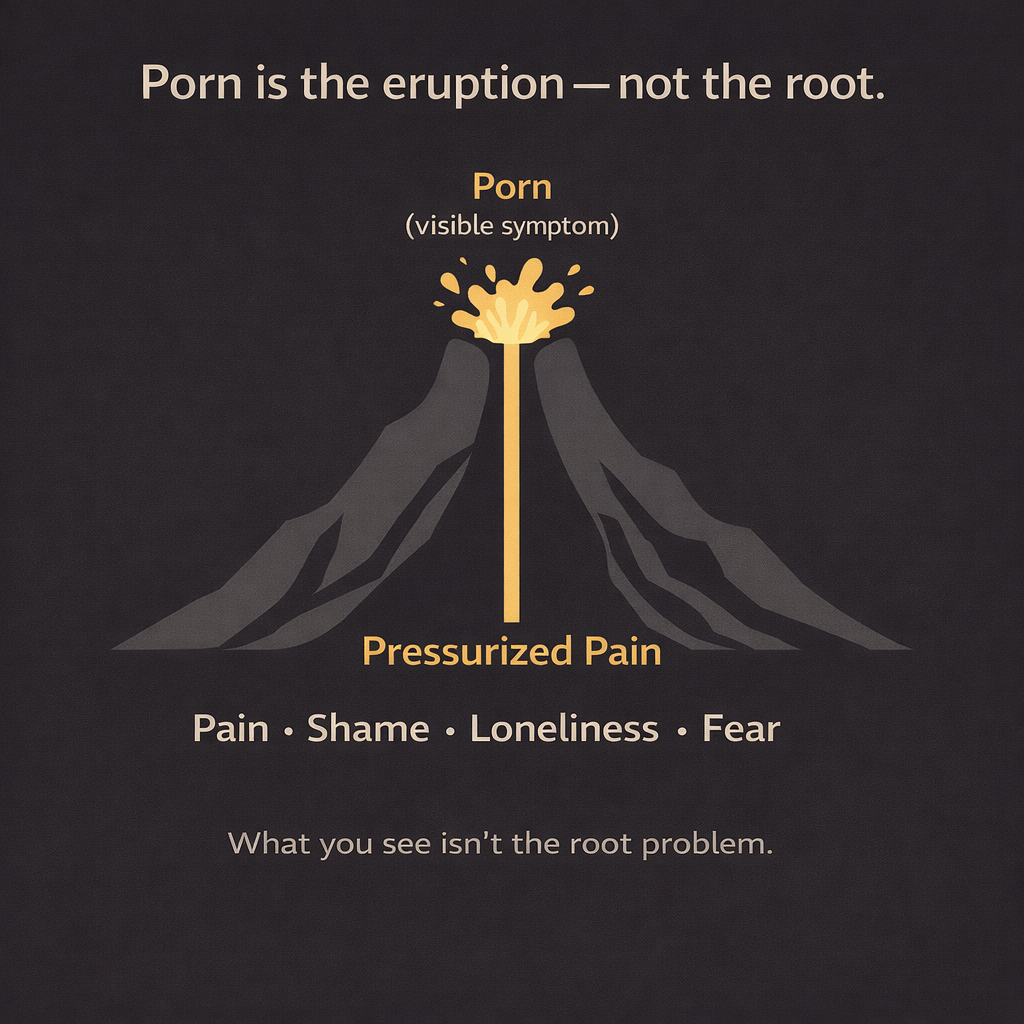
This is where I think the church (big C) can learn something: we often look at the behavior, label it the problem, and get overly conscious about sex—then assume if we can manage the behavior, everything goes away.
But guys in the church will tell you:
“I’ve tried that. I’ve tried to manage the lava. I’ve tried to redirect it, slow it down… and it just keeps erupting.”
Because the pressure cooker is still there. So if you’re treating porn like it’s purely a moral issue or “sexual brokenness” that you just need to manage better, we’re telling you straight:
That response is inadequate.
Not because morality doesn’t matter—but because it’s only touching one piece of what’s really going on.
“You’re Not Addicted to Porn. You’re Addicted to Escaping.”
This is one of the most common lies men tell themselves: Porn is a symptom, not the problem.
And the deeper version of that is:
You’re not addicted to porn, you’re addicted to escaping.
You’re addicted to feeling better.
Because what’s going on “in the magma zone”—under the surface—doesn’t disappear because you ignore it. It pressurizes. It expands. And it’s going to vent somehow.
So what happens?
• Fear becomes anxiety (stress)
• Anger becomes depression
• Healthy shame can become toxic shame
• Loneliness becomes isolation (or apathy)
And when you get there your body, your brain, your nervous system has a way of coping. Most of it was learned early, long before you were “cognitively online.”
And here’s the problem:
Just because you’re an adult now doesn’t mean your brain magically knows how to deal with pain in a mature way, especially since it was never taught.
So when you experience pressure, your system reaches for what it knows:
escape, numb, create space from the stress.
Porn is one option. So is drinking. Gambling. Doomscrolling. Anything that takes your attention off the thing that actually needs attention.
The Cycle Always Begins and Ends With Pain
We’ve used this analogy before: the cycle you get stuck in daily life always begins and ends with pain. Yes, some pain comes from old wounds, unmet needs, trauma, brokenness, things done to you or things you’ve done.
But there’s also another layer:
every human being has needs on the regular.
Regardless of how “good” your story is, you live in a cycle of needing needs met.
And when those needs aren’t met, you’re left with the question:
“Where do I go? What do I do?”
That’s where things get maladaptive especially if you’ve learned to meet your needs in isolation or disconnection.
We say it all the time (and we didn’t come up with it):
The opposite of addiction isn’t sobriety—it’s connection. It’s relationship.
So why talk about needs?
Because needs keep you in relationship.
And the pathway usually looks like this:
I feel → I need → I choose (to meet that need in relationship)
If you’re unable or unwilling to experience your feelings, you’ll have a hard time getting to what you need.
If you can’t name what you need, you can’t stay in relationship.
Then you’re just reacting out of old relational patterns. And if those patterns were formed under unhealthy conditions… guess how you’ll show up as an adult?
Recovery Isn’t Behavior Management. It’s a Better Way to Live.
This is a core Restoration Soul Care principle:
When we look at restoration, when we look at recovery, we are not looking at behavior management. We are looking at a better way to live.
And that’s why it takes time.
Because for a lot of guys, pornography has made sense in your story. That’s why you keep going back to it. It’s been reinforced by neurochemistry and repetition—but it’s not random. It’s not just “your sex drive is out of whack.”
There’s a reason you do what you do.
So we tell guys:
Pay attention to pain.
Because when you feel triggered—when you feel the pull to act out—there’s usually something kicking around underneath the surface.
Pain Isn’t the Gift. But Pain Can Be an Opportunity.
We want to be careful here.
We’re not saying pain itself is good. And we’re definitely not saying, “Suck it up buttercup,” especially if you’ve been through big trauma. That’s insensitive and inaccurate.
But we are saying: post-fall, we often have distorted relationships with pain—and the gospel invites a different relationship with it.
The beauty of grace is that brokenness is not the final verdict of your life.
You’re not a victim to it.
James 1 talks about viewing trials differently—as an opportunity.
Not: “How do I get away from this?”
But: “How does this work for me?”
“What can I gain from this?”
“How can this produce something in me that I can’t get any other way?”
That mindset matters in porn recovery because it puts you back in the seat of responsibility.
You can say:
“Yeah, that happened.
And now what do I want to do about it?”
Jesus Doesn’t Just “Use It.” He Weeps First.
This part matters.
Some guys hear “pain is an opportunity” and think, “So you’re just telling me there’s a silver lining behind stormy clouds and I should embrace it.”
But when pain is heavy—when you’re in the throes of fallout, divorce, depression, consequences—it can feel unbearable.
That’s why I love John 11.
Jesus loved Mary and Martha… and still stayed where he was a few days longer. That’s hard to reconcile.
But when he finally arrives, before he fixes anything—he weeps.
So the good news of Jesus isn’t only: “This will work out for your good, just hold on.”
It’s: Jesus is present first. And he weeps.
He feels the reality of your pain. And there’s a complexity to it—sorrow and a righteous anger toward what’s broken and not how it should be.
And then, yes—he also redeems it. He uses it to grow faith, to open eyes, to reveal where life is truly found.
I’ve heard it said this way:
There isn’t an ounce of your pain Jesus will waste.
That’s good news.
Pain Is the Price of Progress (and Relapse Isn’t the End)
In recovery we say: pain is the price of progress.
And progress usually looks like “failing upward.”
Success rejects all first-time applicants.
A lot of the loudest voices online are “miracle stories”:
“I quit cold turkey overnight and never went back.”
That’s a small minority.
And even then, if you zoom out, a lot of guys just managed the behavior while the tectonic plates were still shifting underneath—so the pressure shows up somewhere else: food, anger, work, social media, isolation.
For most men, recovery is longer. There are setbacks. There may be relapses.
So we say:
Expect that relapse might happen so you can plan for it.
Not “plan to relapse,” but don’t be shocked by it.
Because if your mindset is “I’m done forever and I’ll never struggle again,” and that’s as deep as you go, you’re setting yourself up for prolonged failure.
Your falling is not failure. Your quitting is.
And one of the most helpful things we do in coaching is unpack the relapse—because it contains information you probably couldn’t get any other way.
Relapse is grief-worthy… but it’s not the end. It can be used for growth toward good.
Sit With Pain: Endurance, Reality, and the Window of Tolerance
One thing I tell guys:
When you’re experiencing pain—as unpleasant as it is—it can be an indicator that you’re dealing with reality.
And when you can sit with that pain, you’re reversing the escapism mindset. You’re saying:
I can face reality and it won’t be the end of the world.
It won’t totally consume you.
This connects to a concept we call a “window of tolerance”:
How long can you sit in pain before you feel the need to numb or escape?
That window can grow.
The old path may be reinforced—but it doesn’t mean you have to keep walking it.
That’s why we said it in the episode and we’ll say it again:
Pain is the path toward progress.
Get Out of the Boat (Even If It Costs You)
Sometimes making progress is painful because the people around you won’t understand what you’re doing.
Some guys are surrounded by friends or family who normalize porn—“it’s not a big deal.”
But you know it’s damaging. It’s hindering your relationship with God and the people you love. And you may be the lone guy saying:
“I’m pulling the plug. I don’t want this anymore.”
That can cost you community.
But the reward on the other side is what you actually needed all along:
relationship, freedom, clarity.
And the lie of toxic shame is always the same:
“You’re the only one.”
As long as you believe that lie, you’ll stay in the boat.
Practical Next Steps: Regret, Damage Inventory, and a Letter to Yourself
We always want to give guys a way to put this into practice.
There’s a line in 12-step circles:
Until the pain of staying the same is bigger than the pain of change, you’ll never be free.
And one way I say it is:
Your regret has to outweigh your fear of change.
Regret is powerful because it includes multiple emotions:
sadness, frustration, disgust, that moment of “no more.”
Not as a final state—but as ownership.
Because if you never sit with the cost, there’s no lasting change.
Here are a few ways we recommend getting in tune with healthy regret:
1) Do a Damage Inventory
Make an accurate account:
• How has this cost me?
• What damage has it caused?
• What has it taken from my relationship with God, my spouse, my integrity, my mind?
Not to rehearse daily—but to tell the truth.
2) Listen to Someone Affected (Without Defending)
If you have someone who can articulate the impact in a measured way, listen:
No fixing. No reacting. No argument.
Just receive it.
3) Write a Letter to Yourself
Put words to what you hate and what you don’t want anymore.
But don’t stop there—also write what you believe is true in Christ:
• Victory is possible
• Your freedom has been purchased
• Your identity and worth are not up for debate
Because hope without honesty is fake.
And honesty without hope is crushing.
Shame, Guilt, and Why You Can’t Heal Alone
We differentiate shame because we think it matters:
• Healthy shame is awareness of limitation, sin, woundedness. The gift is humility: “I need help.”
• Toxic shame says, “They will reject me,” and pushes you into isolation.
Guilt is different too:
“I’ve done wrong.”
And the gift of guilt is freedom and forgiveness.
But you can’t move toward forgiveness if you never experience what’s true.
That’s why we say it like this:
You have to feel if you want to heal.
And we say it every episode:
Do not do this alone.
The best step you can take with your pain is sharing it with somebody else.
Clear Takeaway
If porn keeps pulling you back, don’t just stare at the lava.
Look underneath the surface.
Name the pain.
Name the need.
Move toward connection.
Because porn isn’t the ultimate issue.
You’re not addicted to porn—you’re addicted to escaping.
And the path forward isn’t more shame or stricter behavior management.
It’s a better way to live.
Free Help and Next Steps
If you don’t have someone safe in your life right now, come share it with us.
Join our free online community:
Download the Quit Porn Quick Start Guide (free):
(Everything I wish I had when I first started trying to quit.)
Learn more about coaching + resources:
And if this helped, do us a favor send it to one guy who needs it.